The scene is a familiar one. Your child has just lost a game, or a classmate has taken their turn, or things simply haven’t gone as they expected. And you say: “Calm down.” Or “Get a grip.” Or “That’s enough, stop it.” And nothing happens. Or the opposite happens. Self-control in children doesn’t work on command.
Not because they don’t want to. Not because they’re a difficult child. But because self-control isn’t a decision you make when someone reminds you. It’s a skill that develops. And like every skill, it takes repeated practice, not verbal instruction.
The problem is that we’ve spent decades expecting children to regulate themselves when told to. And when they can’t, we conclude that something’s wrong with them, or with how they’re being brought up. We rarely ask whether we’re using the right strategy.
This article explains what self-control really is, why a child’s brain can’t simply “switch it on” when asked, and what kind of experience does train it.
Self-control isn’t obedience. It’s an executive function.
When we talk about self-control in children, we tend to confuse it with obedience. But they’re different things.
Obedience is doing what you’re told. Self-control is being able to regulate your own behaviour from the inside, without anyone telling you. A child can be very obedient in class and fall apart completely over a frustration at break time. And a not very obedient child can have a remarkable ability to calm down when something doesn’t go well.
In developmental psychology, self-control is part of what are called executive functions: a set of thinking skills that let us plan, hold back impulses, keep our attention on something and adapt to change. Self-control, also known as inhibitory control, is one of its fundamental pillars, alongside working memory and cognitive flexibility.
These three abilities are what allow a child to:
- Wait their turn even though they want to speak right now
- Resist grabbing someone else’s toy even though they’d like to
- Change plan when the first one doesn’t work, without getting stuck
- Handle an intense emotion without it taking over completely
When we tell a child to “get a grip”, we’re asking them to use something that’s still under construction. It isn’t a lack of will. It’s biology.
Why a child’s brain can’t “just calm down”
The prefrontal cortex is the part of the brain responsible for self-control, decision-making and emotional regulation. It has one problem: it doesn’t finish maturing until well past the age of 25. In a child aged 8 to 12, it’s quite literally under construction.
When the emotional system fires, because they lost, because someone took something, because something seems unfair, the amygdala sends out the alarm. The prefrontal cortex, in theory, should be able to moderate that signal. But in an 8- or 9-year-old, that cortex doesn’t yet have the infrastructure to do so consistently, especially when the emotion is strong.
It isn’t that the child doesn’t want to. It’s that the brake doesn’t work well yet.
Telling a child to “calm down” at that moment is like telling someone who has just broken their ankle to run. The intention is right. The mechanics aren’t.
That doesn’t mean there’s nothing to be done. It means that what needs doing is different from what we usually do.
What does develop self-control (and what doesn’t)
Self-control doesn’t develop by listening to explanations. It develops by practising in real situations where the impulse is there and the child has to deal with it.
Three conditions that help that development along:
1. Repetition in low-intensity situations
Self-control gets trained when the stakes are small. If the only time your child has to manage themselves is at moments of maximum tension (the fight with their brother, the match they’re losing, the test that goes badly), there’s no room to learn. They also need to practise in small moments: waiting their turn in a board game, keeping to a rule even if they don’t like it, accepting that sometimes it isn’t their moment.
2. Adults who model before they demand
Children learn far more from what they see than from what they hear. If an adult handles their own frustration badly and then asks the child to control themselves, the real message that arrives is inconsistent. Nobody has to be perfect. But it does help to say your own process out loud: “I’m angry right now, so I’m going to wait a moment before I answer.”
3. Play with structure and controlled pressure
This is the most underestimated factor. A study published in Frontiers in Psychology (2025) with 203 children aged 8 to 10 showed that 10-week structured interventions can significantly improve executive functions, including self-control, when they’re designed on principles of progressive cognitive load. Just “playing” isn’t enough. The play that develops self-control has specific features: it creates tension, makes you wait and tests your ability to change your response.
Free play with no structure doesn’t have that effect. Organised play, with rules, turns and real consequences inside the game, does.
Why role-playing games are especially effective
A report from the American Academy of Pediatrics, reaffirmed in January 2025, describes developmentally appropriate play with peers as a singular opportunity to promote the self-regulation skills that build executive function. Not passive play or solo entertainment. Active play, with others, with rules and with real tension.
Role-playing takes this a step further. A 2025 study available on ScienceDirect, on role-playing and social and emotional learning in school settings, concludes that tabletop role-playing games help develop executive functions and social and emotional skills when they’re combined with clear learning goals. Not as stand-alone entertainment. As a tool with structure and purpose.
Why does a role-playing game work especially well for self-control?
The character acts on the child’s behalf, and that reduces the fear of getting it wrong. When a child plays a character, they practise new responses inside a fictional frame. If the character has to wait, deal with a defeat or make a hard decision, the child goes through that experience as emotionally real, but in a safe context. It isn’t them who loses. It’s their character. That lowers resistance and makes them more willing to try.
Decisions have immediate consequences. In a well-designed role-playing game, every choice brings a response from the world around it. The child learns that what they do matters. That acting on impulse has a cost. That waiting sometimes pays off. That link between action and consequence is exactly what’s needed to develop inhibitory control.
The tension is real but manageable. The emotions that come up in a session (the frustration of a plan that doesn’t work, waiting for your turn, the dilemma of choosing between two options without knowing which is better) are real emotions in a controlled setting. The child learns to handle them at just the right level of intensity for their development.
Leryenne as a training ground
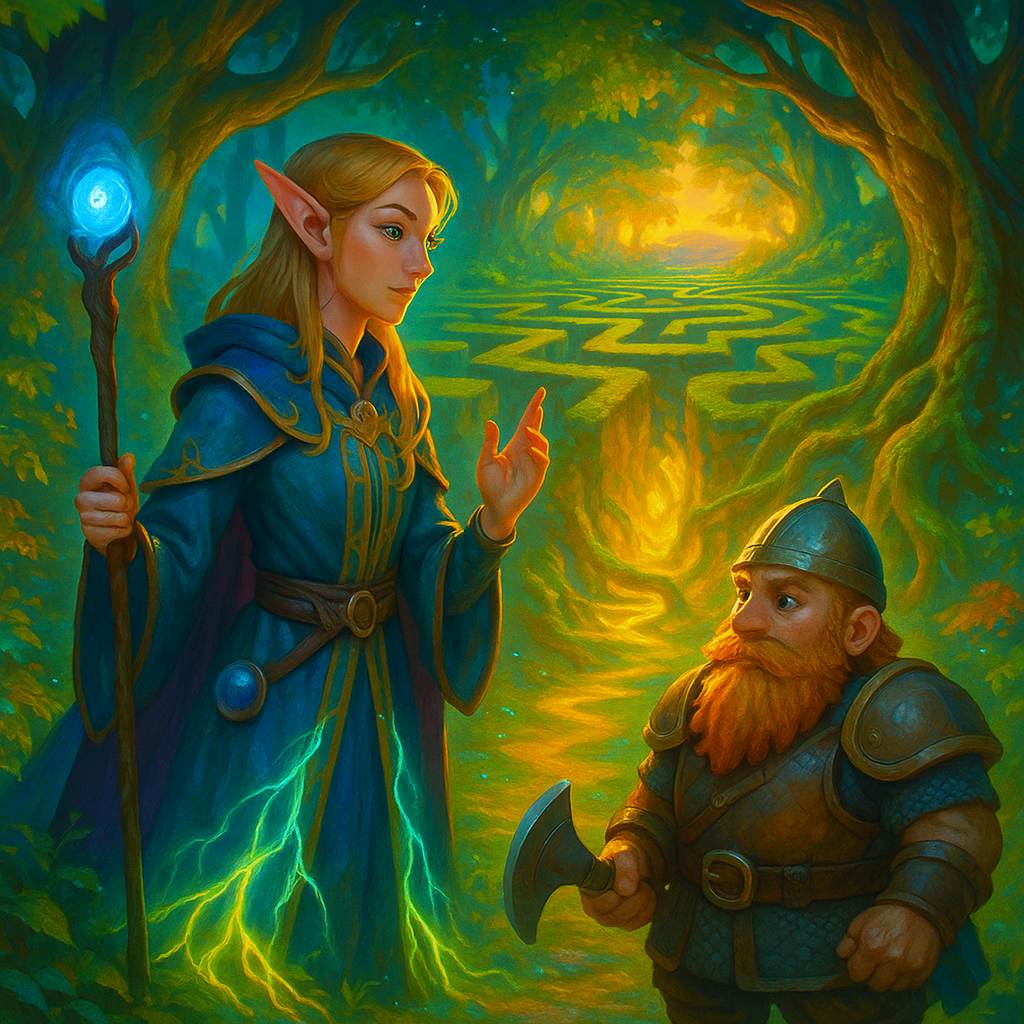
The World of Leryenne is the story universe of Rolin, and it’s free for any family to explore. The Rolin game, which is paid and coming soon, is set there: children become explorers, paladins or mages who have to make decisions at moments of pressure. This isn’t a metaphor. It’s a setting built specifically so that those decisions call for exactly the skills a child needs to practise.
A Rolin mission can’t be solved by reacting on impulse. It takes waiting for the right moment, listening to the rest of the group, giving way when it isn’t your turn, accepting that sometimes the plan fails and has to be remade. It takes, in short, self-control.
What makes it work isn’t the fantasy itself. It’s the structure behind it: characters with motivations, situations with real tension, consequences that matter inside the game. All of that creates the perfect conditions to practise what no talk can teach.
Signs that self-control is improving
Self-control doesn’t appear all at once. It appears in small moments that, if you know how to look for them, add up over time.
Some concrete signs parents and educators can watch for:
- A pause before reacting. Even if it’s only a second. The child who used to explode immediately starts to pause slightly before answering.
- Able to wait their turn without an adult stepping in. Not always, not perfectly, but they start to do it on their own.
- Can go back to an activity after a frustration. Before, they’d give up or stay wound up for a long time. Now they come back sooner.
- Accepts changes of plan with less resistance. Plan B stops being a catastrophe.
- Names what they feel before or after acting. “I was really angry” is a sign of emotional self-awareness, which comes just before self-control.
These signs don’t appear overnight. And they don’t appear because someone has explained to a child how to calm down. They appear because the child has had enough chances to practise, in safe situations, with support and with time.
What we can do (without it feeling like a lecture)
The first step is to stop using self-control as a demand and start treating it as a skill.
Don’t say “get a grip”. Create the conditions for them to practise. That means:
- Bringing in games with rules that require waiting and adapting
- Not stepping in too early when things get complicated
- Letting the game’s consequences do their work without rescuing them from the discomfort
- Talking about it afterwards, not during: “I saw you had a hard time when the rule changed. What did you do?” rather than “you should have controlled yourself”
And if your child is between 8 and 12 and you’d like a tool designed specifically for this, you can see how Rolin’s missions create exactly that practice setting, with a fantasy story that draws them in and a method working on the skills underneath, without it feeling like an exercise.
Because that’s what works. Not lectures. Repeated experience in a setting that makes it possible.