Your child knows the answer. You can tell. And still, their hand stays down, because they’re afraid of making mistakes.
Or they start a drawing, don’t like the first line, and tear it up before going on. Or they decide not to join the football team because they’re “no good at it”. Or they tell you they’d rather not try than risk doing it badly.
It isn’t laziness. It isn’t lack of interest. It’s fear of getting it wrong.
And although it looks like a small problem, it has big consequences. According to a June 2026 article in the Spanish education publication Magisnet, fear of error has become “the great silent epidemic of the classroom”: an invisible barrier that stops many children learning, taking part and growing.
The important thing is this: your child wasn’t born with that fear. They learned it. And what’s learned can be unlearned.
Where the fear of making mistakes comes from
No baby is afraid of making mistakes. A baby learning to walk falls over. And tries again. And falls over again. And keeps on trying. They don’t experience it as failure. They experience it as part of the process.
At some point, that changes.
It isn’t that someone one day said: “Mistakes are bad.” It’s subtler than that. It’s the build-up of small signals the world around them sends over time.
The look of disappointment on an adult’s face when the result wasn’t what was hoped for. Being corrected at once, before they can try again on their own. The “but you could have done better” after an achievement. The marking system that rewards results rather than process. Comparisons, even well-meaning ones.
Gómez-López and colleagues (2025) demonstrate that perfectionism and fear of failure feed each other: the more pressure there is to do well, the more fear the mistake brings, and the more paralysing the cycle becomes.
The fear of making mistakes, in most cases, isn’t a personality trait. It’s a learned response.
How it looks at home (and beyond school)
The fear of making mistakes doesn’t only show up in tests. It’s in many more places than we think.
In play: The child who insists on always doing the same things because they know they’re good at them. Who turns down new games because they can’t bear not knowing how. Who gets frustrated out of all proportion when they lose or when something doesn’t go as expected.
In creative things: The one who rubs out more than they draw. The one who won’t let anyone see what they’ve written until it’s “perfect”. The one who abandons projects halfway because the result doesn’t live up to what they’d imagined.
In relationships: The one who doesn’t dare talk to children they don’t know. The one who’d rather stay quiet than say something that might sound odd. The one who doesn’t ask for help because they’re embarrassed not to know.
At school: The one who doesn’t put their hand up even though they know the answer. The one who hands in a blank sheet rather than something unfinished. The one who freezes in a test, not because they haven’t revised, but because the fear of making mistakes locks up their thinking.
All these behaviours have something in common: a child who has learned that getting it wrong costs too much.
The problem isn’t the mistake. It’s what we learned to think about it.
This is the key.
In real life, mistakes are information. They’re how the brain adjusts its model of reality. When you get something wrong, you activate brain circuits that help you retain what does work. We don’t learn in spite of mistakes: we learn thanks to them.
A study by Peterson and colleagues (2025) demonstrated it clearly: children brought up in settings that value reflecting on mistakes, where getting it wrong isn’t a problem but an opportunity, develop greater self-confidence and more resilience in the face of failure.
It isn’t that mistakes don’t matter. It’s about what we teach a child they mean.
“See? I told you.” → The mistake proves you were right.
“Let’s see what happened.” → The mistake is a door.
The difference between those two sentences isn’t a nuance. It’s a philosophy of education. And the hardest part is that many of us inherited the first without knowing it.
Why a role-playing game creates the space children need
The problem with fear of error is one of context. A child afraid of making mistakes needs a space to practise where there are no real consequences. Where trying isn’t a gamble but an exploration.
That space doesn’t exist in the classroom. Marks carry weight. Classmates are watching.
It doesn’t always exist at home either. The adult’s gaze matters. Comparison with what was “expected” creeps in.
A role-playing game creates something different.
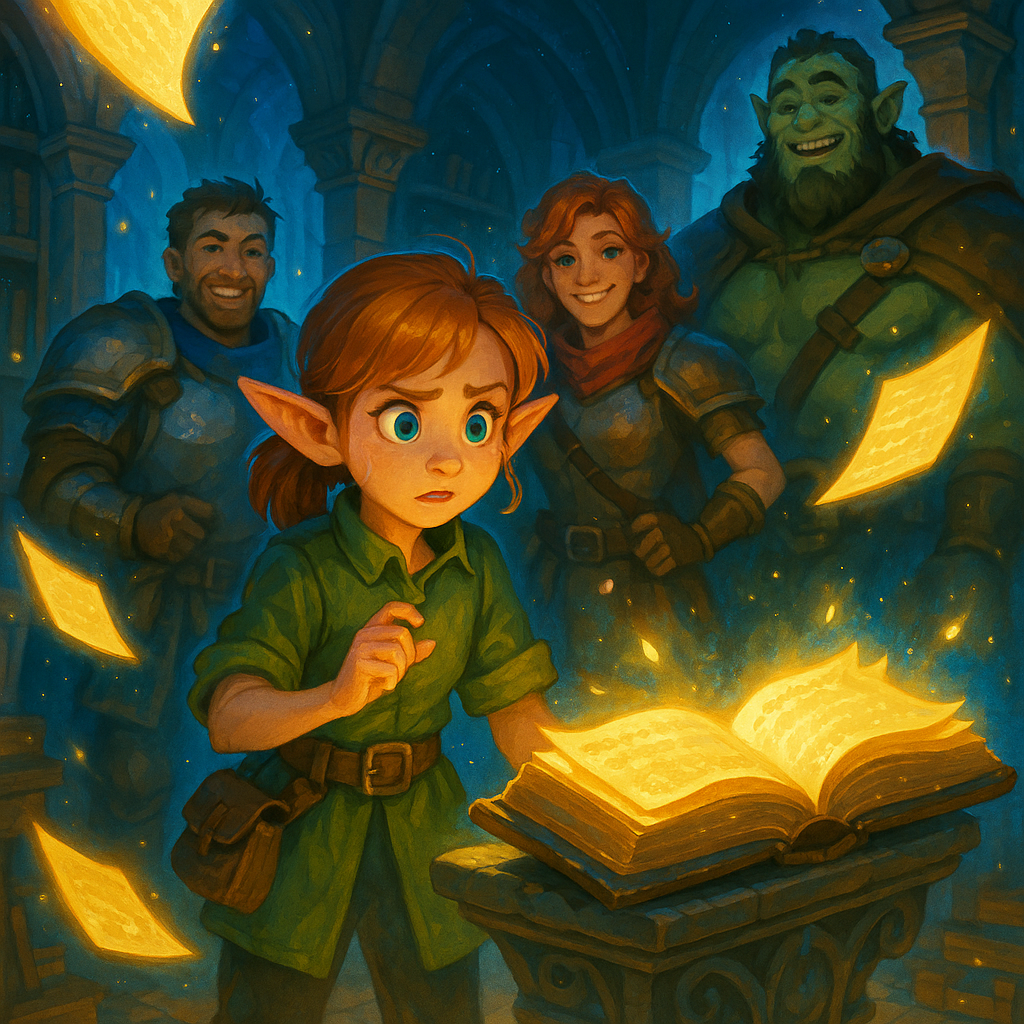
In a mission of the Rolin game, which is coming soon and is set in the World of Leryenne (the free story world that any family can explore), when a character fails, there’s no mark. There’s no disappointment. There’s a new situation to resolve. The story doesn’t end: it carries on. And the child learns, inside the adventure, that a mistake is part of the road, not the end of it.
This isn’t just a metaphor. It’s a mechanic.
In the game, getting it wrong has consequences in the story, not personal ones. The character has a hard time; the child learns. And that separation, between “my character failed” and “I’m a failure”, is exactly what some children need to start letting go of the fear.
Over time, that learning carries over. Because practising getting things wrong in a safe setting changes the relationship a child has with mistakes in general.
What you can do this week
There’s no magic formula. But there are concrete ideas that change the pattern:
Talk about your own mistakes. Not to feel sorry for yourself, but to make them normal. “I really messed something up today. Look what I learned.” Children learn more from what they see than from what they hear.
Change the questions after school. Instead of “did you get everything right?” or “how did the test go?”, try: “What was the hardest thing today?” or “Was there anything you didn’t understand and had to ask about?” That way you make mistakes and doubts a normal part of the day, not failures to hide.
Celebrate the attempt, not only the result. “The fact that you tried already counts for something.” Not as empty comfort, but as real recognition of the effort. Children who get that message learn that trying has value whatever the result.
When something goes wrong, ask: “What would you do differently next time?” Not “why did you do that?”, which is a judgement. But what they’d do differently. That teaches them to use a mistake as information, not as a sentence.
Create moments of free play where mistakes don’t matter. Board games, building, drawing with no goal, making up stories. The more places they have to fail without consequences, the more flexible their relationship with mistakes becomes.
In closing
A child afraid of making mistakes isn’t a coward or a difficult child. They’re a child who has learned that getting it wrong costs more than they can afford.
Changing that isn’t the work of a day. But it isn’t impossible either. Start by changing how you respond when things don’t go well. And look for spaces, inside and outside the home, where your child can practise failing without drama.
Because the question isn’t whether they’ll get things wrong. It’s whether they’ll be able to learn from it.
At Rolin we’ve designed role-playing adventures precisely to create that space: where every failed mission is the start of a new strategy, and where children discover that trying is worth more than doing it perfectly. If you’d like to know how it works, the free guide is at metodorolin.com.