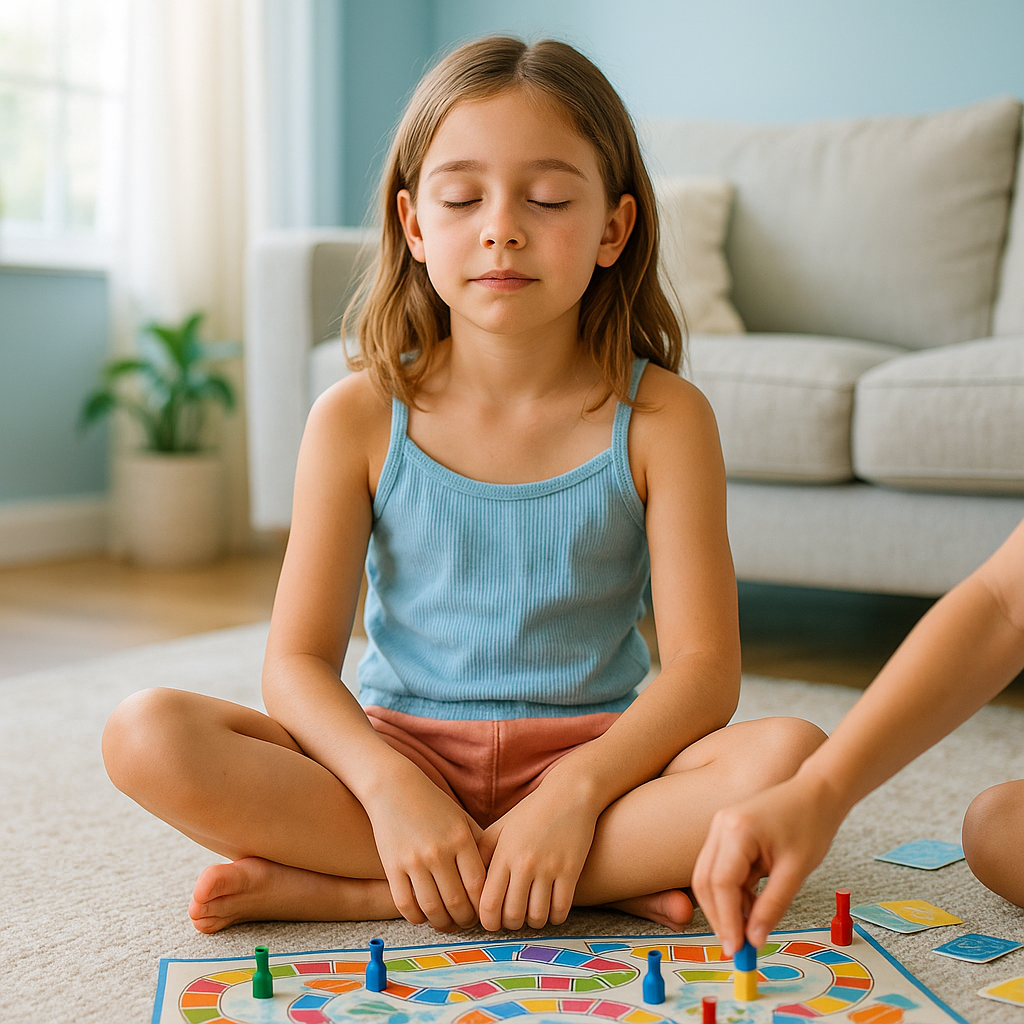
School holidays. A long afternoon at home. A board game in the living room. You’re winning, and if your child is a sore loser you know exactly what’s coming: the moment their last piece falls, drama is guaranteed. Tears, accusations that you cheated, walking out of the game or, in the most intense version, pieces all over the floor.
And your first thought is: “Why can’t they just lose like a normal person?”
Short answer: because they’re still learning. Longer answer: because losing sets off something in the brain very like a real threat, and their nervous system doesn’t yet have the tools to deal with it. But, and this matters, those tools can be learned. And the holidays, with all the games they bring, are a golden opportunity that a lot of families let slip without meaning to.
What happens in the brain when a child loses
When a child loses, their brain registers that defeat in a way similar to how it registers social rejection or physical pain. This isn’t a metaphor: the amygdala, the area of the brain responsible for alarm reactions, fires strongly when something we were expecting doesn’t happen.
And there’s one fact that explains almost everything: the prefrontal cortex, the part of the brain that helps regulate those emotions and put a loss into perspective, doesn’t finish maturing until the age of 25. In an 8-year-old, that area is quite literally under construction.
In practical terms: it isn’t that your child “doesn’t want” to control their reaction. It’s that it costs them more than it costs you. Their emotional brain is shouting loudly; their rational brain doesn’t yet have the strength to answer back.
That doesn’t mean it shouldn’t be worked on. It means it takes practice and support, not lectures.
The trap of protecting them too much from failure
A lot of families, without realising it, remove the situations where a child might lose. They let them win to avoid the drama. They don’t sign them up for competitive activities because “they have a terrible time”. They take them out of the game before they lose so as not to have to deal with the explosion.
The result: the child never practises losing. And what isn’t practised isn’t learned.
It’s like wanting them to learn to swim without letting them into the water.
The frustration they feel when they lose is uncomfortable for them, and for you too, having to watch them suffer. But that discomfort is precisely the ingredient they need to develop tolerance for frustration. And that tolerance is one of the most useful skills for life: at school when something doesn’t work first time, in friendships when there’s a conflict, in any project that takes a long process.
Recent research on emotional regulation confirms that this tolerance can be trained, and that play settings are especially good for it, because they offer real emotional consequences at a very low real cost. The world doesn’t end because you lost at Ludo.
What you’re teaching without realising
When you let a child win to avoid a conflict, you’re sending an implicit message that goes deep: “Losing is so bad that we have to avoid it.” And that doesn’t help them. It confirms the fear.
There’s a subtler trap too: how you react when you lose. If you’re playing cards with your child and when you lose you say “What bad luck!” calmly and carry on without any fuss, you’re teaching with your whole body what no talk can teach.
A study of more than 900 children in sporting competition, published in the British Journal of Educational Psychology, showed that children who focus on learning, on improving and on enjoying the process, report greater emotional wellbeing and self-esteem than those who focus only on winning. The key lies in how they frame defeat. And they mainly learn that approach from the adults around them.
It doesn’t take a speech. It takes them seeing how you do it.
What not to do when they lose control
When a child loses and explodes, instinct usually takes us to one of these places:
- Lecturing in the heat of the moment: “That’s enough, it’s only a game.”
- Trying to reason: “We all lose sometimes, it’s fine.”
- Threatening: “Carry on like that and the game’s over.”
- Or at the other extreme: “Don’t worry, you’re sure to win next time.”
None of these works well in the moment. When a child is in the middle of an emotional reaction, their amygdala is lit up. They can’t process complex reasoning. The message doesn’t get in. Talking a lot at that point usually feeds the spiral rather than putting it out.
What does work:
Name the emotion without judging it. “I can see you’re really angry. Losing is maddening.” You don’t need to add anything else right then.
Wait. The nervous system needs time to come down. Five minutes of calm silence do more than five minutes of explanations.
When they’ve calmed down, and not before, one brief question: “How did you feel when you lost? What could we try next time?” One question, not an analysis.
Don’t drag out the conversation. Children don’t process long reflections on their own emotions well. One idea, well planted, is plenty.
The conversation that really helps doesn’t happen at the moment of the drama. It happens when they’re calm, or better still, during the game, before the loss arrives. “Hey, do you know what I’m going to do if I lose this one? Try to remember the move I liked best.”
How to use games these holidays so they can really practise
Games have something special about them: the consequences are emotionally real but practically safe. When your child loses at Uno, nothing serious happens in the real world. But their brain experiences it as a real loss, and they have to deal with it.
That’s exactly what they need: practice with manageable consequences.
Start with games where chance plays a big part. Ludo, Uno, Snakes and Ladders, memory card games. Because luck counts for so much, defeat is easier to accept: “I just kept rolling badly.” Their ego is better protected at first, which makes it easier to keep playing without exploding.
Talk about how you feel when you lose. Before it happens to them, out loud and naturally: “Oh, I’ve landed on the worst square. That’s a bit annoying, isn’t it? Oh well, let’s carry on.” Not theatrical. Natural.
Celebrate the process, not just the result. “You played that bit really well”, “that was a clever move”, “you held on so well when it looked like you were going to lose”. A child needs to learn that losing doesn’t wipe out all the good things that happened during the game.
Put a name to the emotions before the defeat. “How do you think you’ll feel if we lose this one?” Talking about the emotion ahead of time makes it less threatening when it comes.
Use story-based play as a space to practise. In a role-playing game, characters fail missions, make mistakes and have to try again. A child experiences the frustration of their character, which isn’t quite their own, and gradually learns to process that discomfort from a small emotional distance. It’s one of the reasons story-based play works especially well for children who struggle with failure: the “me” is slightly protected by the character, which makes frustration easier to bear and easier to practise.
It isn’t a question of character
It’s easy to label: “they’re very competitive”, “they’re a bad loser”, “they’re so dramatic”. But those labels say little about the child and a lot about the skill they’re still learning.
Learning to lose isn’t a question of character or willpower. It’s a skill that gets built, like all skills, with practice and with the help of adults who also know how to handle defeat.
These holidays, every lost game can be a small lesson in resilience. All you need to do is play, stay alongside without rescuing, and trust that the process is working, even when it doesn’t look like it.
If you’d like to explore how an educational role-playing game can help your child practise frustration, conflict and decision-making in a setting that truly grabs them, you’ll find all the information about the Rolin Method here. And if you’d rather start with a free guide, that’s there too.