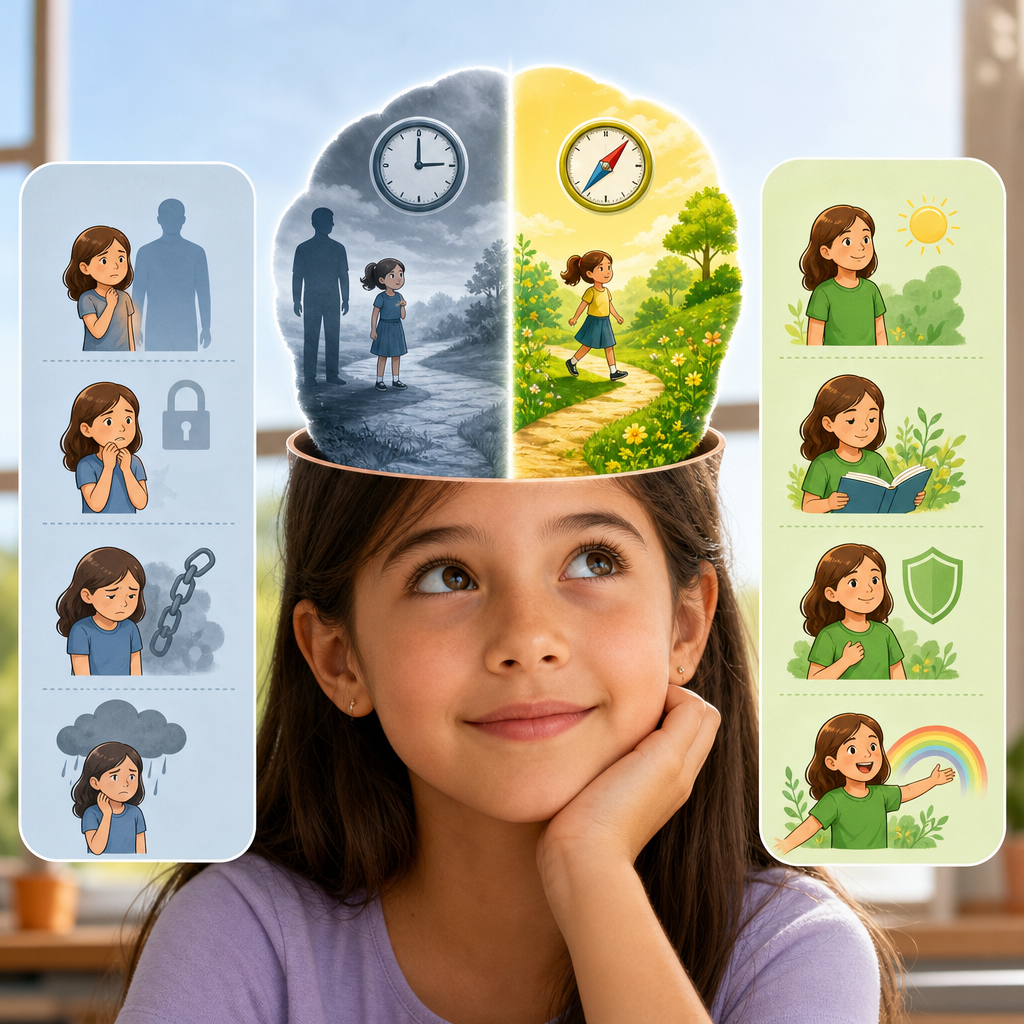
I told them to put their coat on. No answer, so I said it again, louder: “Because I said so.” On it went, no further argument. At that moment I thought, as so many of us parents think several times a day, that I’d won. Forty minutes later, at the park, another child suggested throwing stones into the pond where there was a duck. I wasn’t standing next to them. They did it. That’s the moment critical thinking in children starts to matter, and “because I said so” doesn’t teach it.
It doesn’t take much imagination to fill that gap: anyone who has spent time around children has seen the same sequence, in a different costume. At home they obey perfectly. Out there, without us in front of them, they decide on their own, and the decision doesn’t always turn out well. And that’s the uncomfortable question I ask myself every time I use that sentence: have I taught them to do the right thing, or have I taught them to listen to me?
They aren’t the same. And the difference explains why some children who “never cause any trouble” at home are exactly the ones who lose their bearings most when there’s no adult nearby telling them what to do.
“Because I said so” works. But only while you’re standing there
There’s half a century of research on child discipline, and with few exceptions it points the same way. The psychologist Martin Hoffman described, decades ago, three ways adults correct a child, each leaving a different moral mark. Power assertion (punishment, threats, “because I said so”) gets immediate obedience, but it’s associated with weaker moral development: the child learns to avoid punishment, not to understand how their behaviour affects someone else. Love withdrawal (“I’m very disappointed in you”) is associated with even worse outcomes. And inductive discipline (explaining the reason, naming the consequence for the other person, expecting them to put it right) is the one linked to stronger, longer-lasting moral development.
The key lies in one word: lasting. Obedience out of fear or hierarchy is external compliance. It depends on someone watching. As soon as the adult leaves the room, the playground or the child’s life for five minutes, the reason for behaving well goes with them. A child’s own judgement, on the other hand, doesn’t need witnesses. That’s why a child can be faultless at the table and, half an hour later at the park, join in without a second thought with something they’d never do at home.
The nuance that makes this defensible: not every instruction is up for negotiation
None of this means every rule has to be argued out like a parliamentary debate. Some instructions get followed right now, no discussion: “don’t cross”, “let go of that”, “stop”. They’re about safety or urgency, hierarchy exists there for a clear reason, and there’s no need to apologise for using it.
The problem isn’t that those instructions exist. It’s when they become the default model for everything else: for putting on a coat, sharing a toy, saying sorry. There you can, and it’s worth it, explain the reason. Holding to the instruction and giving the reason aren’t opposites. You can insist the coat goes on now, and explain ten seconds later why it’s cold out. A child who can tell which is which (“this isn’t up for discussion now, this one we can talk about”) has judgement. One trained only to obey doesn’t.
The cost almost nobody names
There’s one more argument that rarely gets said out loud, and it’s worth saying calmly, without dramatising it: a child trained never to question an adult is, by definition, more vulnerable to situations of abuse and to peer pressure in adolescence. Guides on preventing child abuse explain it explicitly: children need to be taught that respect isn’t submission, and that a child can say no to an adult when something makes them uncomfortable, isn’t clear to them, or involves being asked to keep a secret.
This isn’t an argument for frightening anyone or for sowing general mistrust of the adults around a child. It’s simply one more reason, among several, for teaching the difference between obeying without thinking and deciding with judgement. The more a child is used to asking “does this make sense?” rather than “who’s telling me this?”, the better equipped they are for both scenarios: the harmless conflict at the park and the one that isn’t harmless.
Explaining the reason doesn’t mean losing authority
The belief that props up so many adults’ “because I said so” is that explaining the reason weakens your hand. That’s exactly the opposite of what the research finds. The psychologist Diana Baumrind classified parenting styles decades ago along two axes, warmth and control, and found that the one combining both at a high level (it demands, and it also reasons and listens) produces the best results in social competence, self-esteem and achievement. Neither the purely authoritarian (“because I said so”, full stop) nor the permissive (“do what you like”) reaches that level.
Ryan and Deci’s self-determination theory provides the missing piece: motivation is taken on board when the adult gives real opportunities to decide and explains the purpose of what they’re asking, not only the instruction. And there’s a finding that matters especially for those who work with groups of children, not just for parents: this way of teaching can be trained. A 2021 study by Reeve and Cheon shows that teachers and education teams can learn to support autonomy deliberately, with measurable results in the classroom. It isn’t a matter of character or of “having a way with children”. It’s a skill, and like every skill, it gets practised.
This doesn’t replace setting clear limits (we’ve talked about that in How to Stop Shouting at Your Child and Still Set Limits), it complements it. A limit can be held in a calm voice and, on top of that, with the reason laid out on the table.
In the dining hall or the classroom it’s the same, on another scale
After years of working alongside families and education teams, in school settings and school dining halls, we saw the same dynamic multiplied by thirty whenever one adult was alone with a large group. “Because I said so” is quicker, and with thirty children in front of you the temptation to use it all the time is huge. The problem is the same, only bigger: the child who obeys without a murmur in the dining hall because the lunchtime supervisor is watching, out in the playground with no direct supervision, decides with the only judgement they’ve been trained in, which is none.
The difference between an adult who manages a group with authority and one who only imposes obedience isn’t in the volume of their voice. It’s in whether, when there’s time (and there are nearly always ten seconds to spare, even if it doesn’t feel that way), the reason gets named before or after the instruction: “this gets picked up now, because otherwise someone will trip and get hurt”. A group of thirty learns a rule much faster when they understand what it’s for than when all they know is that there’ll be a telling-off if they don’t follow it.
Why a role-playing game is the one place they practise deciding alone
This is why the subject matters so much to us at Rolin. A role-playing game is, by definition, a place where you have to decide without anyone telling you what to do. The character reaches a crossroads, help an ally and take a risk or protect themselves and leave the ally behind, and the decision is made by the child, not by the adult leading the session.
What changes everything is what happens next. In real life, when a child makes a poor decision, the consequence tends to arrive as a punishment disconnected from what happened, or doesn’t arrive at all because nobody found out. In a well-led session, the consequence appears inside the story itself (an ally stops trusting the character, a mission gets complicated, something is lost) and a trained adult then names out loud, without a lecture, what happened and why. The child connects the decision with its effect, session after session, without anyone needing to say “because I said so” at any point.
That’s exactly the opposite of obedience through fear of punishment. It’s practising judgement in a space where getting it wrong doesn’t cost a telling-off, but brings a new chance the following week.
What you can try this week
You don’t have to change how you talk to your child or your group of children all at once. One thing is enough: next time you’re about to say “because I said so” about something that isn’t urgent, add one short sentence after it. Not to negotiate the instruction, which stands, but so that the reason has been said: “turn the tablet off now, because you’ve been on it for over an hour and then you find it hard to sleep”. The limit doesn’t move. What changes is that, next time, they might be the one to remind themselves, without you there.
With a younger child who still finds it hard to wait for the end of your sentence, it works to reverse the order: first the reason, in one line, and the instruction last. “It’s cold out, so coat on.” With an older one who can sustain a bit more conversation, it helps to add the question afterwards, not before: first the instruction gets followed, and then, unhurriedly, “what do you think would have happened if we hadn’t done it that way?” It isn’t to justify yourself to them. It’s so they can practise the reasoning they’ll one day have to do alone, without you beside them.
If you’d like to give your child or your group a real space to practise decisions with real consequences, week after week, you can find out how we work on this in the free guide at metodorolin.com.
Anayda and Sergi