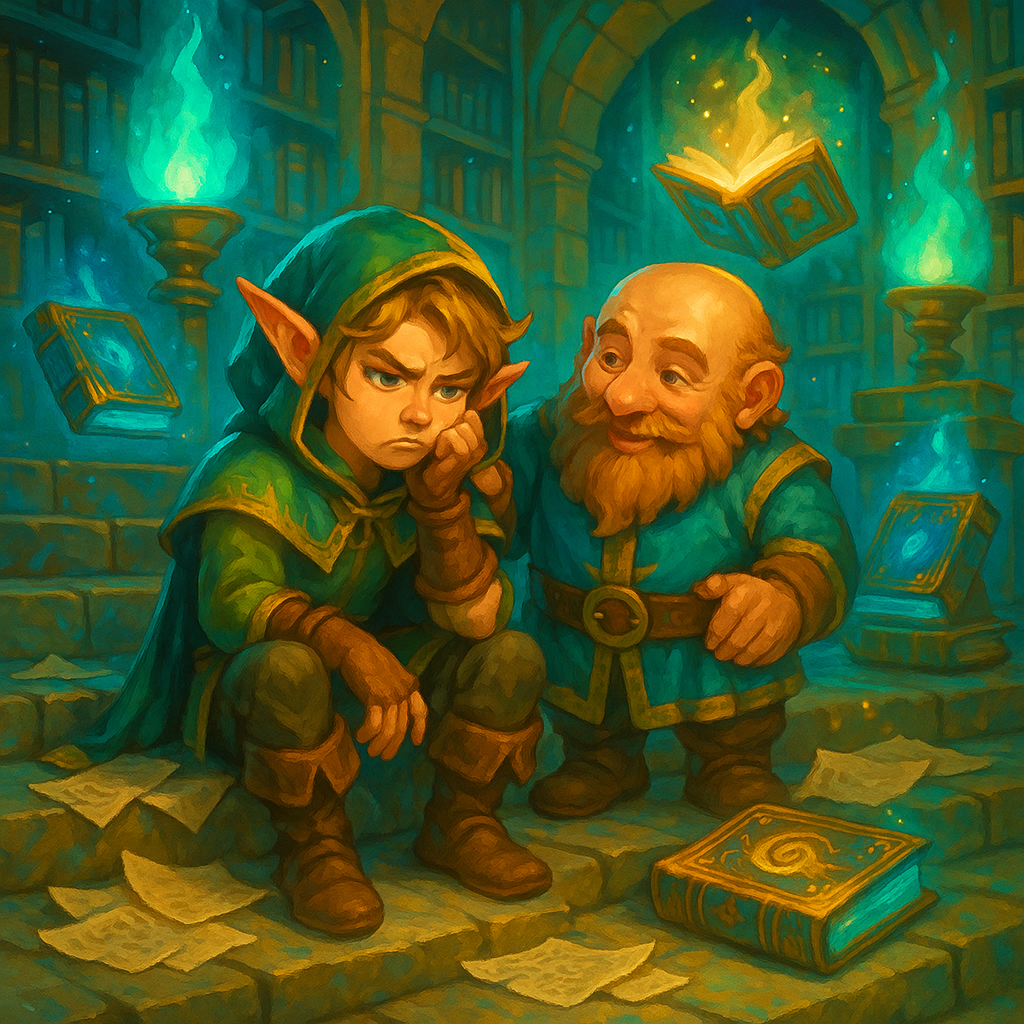
Your child has been doing homework for ten minutes. The problem won’t come out. They get up from the chair, throw the pencil and declare it impossible. Or they’re playing a board game, lose twice in a row and don’t want to carry on. Or they try something new (riding a bike, a recipe, a hard puzzle), it goes wrong the first time and it’s put away in a drawer forever. Low frustration tolerance in children often looks just like this.
Our first thought is that it’s laziness. Or they can’t be bothered. Or too much pride. But what’s going on, almost always, is something more specific: they haven’t yet built up much tolerance for frustration.
And here’s the part that changes how you see it: this isn’t a flaw of character. It’s a skill. A skill that can be practised, the way times tables or passing a ball are practised. And like every skill, it needs the right setting to be trained. Not lectures. Not talks on the importance of effort. Real practice, with real consequences, in a setting where failing isn’t a catastrophe.
That’s what play offers that few other things do.
What frustration tolerance is (and isn’t)
Frustration tolerance is the ability to keep functioning when something doesn’t turn out as we expected. To handle discomfort, anger or disappointment without giving up or falling apart.
A child with good frustration tolerance isn’t one who never gets angry. It’s one who gets angry, notices, regulates it and keeps trying. One who learns that “this is hard right now” isn’t the same as “this is impossible forever”.
It matters to be clear about this, because a lot of adults confuse frustration tolerance with resignation or passivity. It has nothing to do with them. A child who keeps quiet while overwhelmed inside isn’t being tolerant: they’re suppressing. A child who says “this is hard and it’s making me angry, but I’m going to try again” is.
Frustration tolerance is the bridge between effort and learning. Without it, a child gives up before getting anywhere. With it, failure becomes useful information rather than a reason to stop.
Why children today have less frustration tolerance
There are two explanations that researchers have been pointing to for years and that recent data confirm.
The first is the culture of instant gratification. Apps and digital content designed for children are full of instant rewards: lights, sounds, points, levels going up. Each interaction produces a small hit of dopamine. The brain learns to expect that pattern: I do something, I get a reward straight away. When real life doesn’t work like that, and it almost never does, the system collapses.
A study published in 2024 (Fitzpatrick et al.) found that children using tablets 1.22 hours a day at 3.5 years old showed 22% more expression of anger and frustration at 4.5 years. It isn’t only about screen time: it’s the kind of stimulation on offer, designed to remove any friction between wanting and reward.
The second is overprotection. When adults solve a problem before a child has had time to get frustrated with it, when they avoid situations where the child might fail, when they step in at the first sign of difficulty, however good their intentions, the child never trains this muscle.
Science calls it the overprotection paradox: by clearing the path of obstacles, we’re producing children who break at the first real problem nobody can solve for them. Not because they’re weak. But because they’ve never had the chance to practise the opposite.
It isn’t that today’s parents are worse. It’s that the environment has changed. We live in a world where protecting seems to mean removing difficulty. But calibrated difficulty, the kind that takes some effort without overwhelming, is exactly what children need in order to grow.
What happens in the brain when a child gets frustrated
When something doesn’t go as they expected, the limbic system fires up in a child’s brain: the automatic emotional response. Anger, disappointment, helplessness. That happens in fractions of a second and can’t be undone.
What can moderate it is the prefrontal cortex: the part of the brain that thinks before acting, that says “wait, this isn’t an emergency, you can try again”. The problem is that in children aged 8 to 12 this area is still very much under construction. It won’t finish maturing until well into their twenties.
That isn’t an excuse. It’s an explanation. Children don’t give up because they don’t care or because they’re weak in character. They give up because the part of the brain that manages frustration doesn’t yet have the strength to brake the automatic emotional response.
How is that strength gained? Like any other muscle: by practising. By facing situations where something takes a bit of effort, regulating the emotion it brings, and discovering that the world doesn’t end when things go badly.
Why play is the perfect setting to train this
Play with rules, challenges and uncertain results is the natural laboratory of frustration tolerance. When a child loses at Ludo, can’t build the tower of blocks the way they wanted, or draws bad cards for several turns in a row, they’re facing exactly what they need.
But there are important differences between kinds of game.
Video games designed with infinite progression and constant rewards, the ones that let you restart instantly and never offer lasting consequences, don’t train real frustration well. Board games, physical games with rules and, above all, story-based role-playing games offer something different: results that don’t always depend on you, situations where decisions must be made with incomplete information, moments when a character fails and the adventure still carries on.
A study published in Frontiers in Psychology in 2025 looked at the effects of live-action role-playing games on social-emotional competences and found that the tolerance sub-dimension showed significant improvements in participants. The researchers suggest this is because role-playing forces you to make decisions under pressure, to manage the conflict between what we want and what’s possible, and to adapt when the original plan doesn’t work. In other words, role-playing teaches you to give way and keep going. Which is exactly what frustration tolerance means.
Signs that your child has low frustration tolerance
It isn’t always easy to spot. Some clear signs:
- They give up new activities at the first difficulty, before really having tried.
- They react out of proportion when they lose: intense anger, tears, flat refusal to go on.
- They need everything to work first time in order to feel good about it.
- They avoid challenges: they prefer doing things they know they can do over risking failure.
- When they get frustrated, the emotional reaction takes a long time to come down, even after the problem is solved.
None of these signs points to a serious problem on its own. But if your child shows them consistently, it’s a sign they need more chances to practise, in safe settings, what it is to face something hard and not give up.
What’s special about role-playing games for training frustration
In a role-playing game, frustration isn’t an accident: it’s part of the design. The character loses a fight. The plan fails. The mission that seemed simple turns out to be much more complicated. The path someone thought was right leads to a dead end.
And yet nobody stops playing.
Why? Because the failure happens inside a story. It makes sense within a bigger context. There’s something to keep going for. And that’s exactly what we want children to carry over into real life: that when something fails, it isn’t the end. That there’s something more to keep trying for.
A role-playing game also offers something daily life rarely guarantees naturally: the presence of an adult who doesn’t step in but doesn’t walk away either. Who lets the child face the difficulty and is available when real support is needed, not when the child wants the problem solved for them.
That combination of real difficulty, a story context and an available adult is the formula that trains frustration tolerance in a sustained way. Children don’t feel they’re working. They feel they’re playing an adventure. And all the while, they’re developing one of the most important skills of their lives.
To finish
Frustration tolerance isn’t taught with speeches. It’s trained, little by little, in situations where something is hard and a child has room to face it without an adult solving it for them.
If you want your child to learn to handle what doesn’t go as they expect, the best investment isn’t a children’s self-help book or a talk on the importance of effort. It’s creating more chances for them to play, fail, think and try again.
At Rolin, the missions are designed for exactly that: challenges that take effort, decisions with consequences and adventures where failure is never the end of the story. Find out how it works with the free guide.