You’re at the park and your child won’t share. Another child comes over and asks for the bucket or the spade. Yours clutches it to their chest and shouts “it’s mine!” with an intensity you weren’t expecting. The other parent gives an awkward smile. You crouch down and whisper “come on, share, it’s fine”, but your child cries harder and walks off hugging the bucket as if it might vanish.
You apologise with your eyes. On the way home you keep turning it over: are they being selfish? Are we doing something wrong? Why does their cousin hand things over with no trouble at all?
This scene repeats itself at parks, birthday parties and family meals more often than the families living through it would guess. It isn’t an isolated whim. It’s one of the things parents ask about most when they talk about social skills, more even than fights or tantrums.
And the good news is that it almost never has to do with your child’s character. It has to do with something much more concrete: a skill they’re still building, and one that gets built by practising, not by listening to lectures on generosity. Let’s look at what’s really happening when a child refuses to share, what recent research says about why some children share more than others, and what you can do this week without forcing or shaming anyone.
Why your child won’t share (even when there’s no problem at home)
Between the ages of two and four, sharing is hard because the brain hasn’t yet fully grasped that the other child has wants as real as their own. It’s the phase Piaget called childhood egocentrism: your child isn’t being insensitive, they literally find it hard to imagine the other person’s point of view. At that age, a toy isn’t just an object. It’s an extension of themselves, and lending it feels like losing part of their own power.
But if your child is older and “it’s mine” is still making an appearance, the explanation changes. By six, seven or eight, most children understand the idea of sharing and fairness perfectly well. The problem is no longer one of understanding. It’s that certain objects (the new toy, the scarce one, the one with emotional weight) set off a possessive reflex that has nothing to do with what the child knows they “should” do.
This explains something that baffles a lot of parents: the same child who lends things to their brother at home without any fuss digs their heels in at the park in front of a stranger. It isn’t a contradiction. At home there’s trust and a relationship already built; with a child they’ve only just met, there’s no guarantee the object will come back, and the brain reacts by protecting what it does control.
Knowing which phase your child is in changes what makes sense to do. At three, forcing doesn’t help because the concept isn’t mature yet. At eight, the problem isn’t the concept. It’s practice and handling the moment.
What recent research says about why some children share more than others
Developmental science has been studying this for years, and some recent findings are especially useful for parents.
A study published in 2025 in Developmental Science (Chai et al.) found something revealing: children who watch other children make generous choices go on to share significantly more than children who watch random or selfish choices. The researchers call this “goal contagion”. A child doesn’t learn to share because someone explains that they should, but because they see someone else do it and absorb that intention as their own. Seeing weighs more than hearing.
Another recent finding, published in 2025 in Frontiers in Psychiatry, compared the effect of cooperative and competitive games on young children’s behaviour afterwards: exposure to cooperative play increased the generosity and spontaneous helping they showed later, while competitive settings reduced it. The context a child plays in doesn’t stay inside the game. They carry that disposition into the rest of the day.
And a third finding, this time about the youngest children: research shows that soon after they start sharing, children find more satisfaction in giving than in receiving. In other words, sharing doesn’t stay a sacrifice forever. It becomes something motivating in itself, but only after enough practice to get to feel it.
These three pieces fit together: children share more when they see it modelled, when they practise in cooperative settings, and when they get the chance to experience the good part of giving, not when someone keeps telling them “you have to share”.
The mistakes that make them share less, not more
There are several very common reactions to an “it’s mine” that, without meaning to, achieve exactly the opposite of what they’re after.
Making them let go of the toy on the spot. “Give it to them right now” turns sharing into an imposed loss rather than a decision. The child doesn’t learn to share. They learn that sharing is something that happens to them, not something they choose.
Shaming them in front of others. “How embarrassing, don’t be like that” doesn’t produce generosity, it produces shame. And shame doesn’t motivate sharing next time. It motivates hiding the possessive impulse better, or simply avoiding situations where it might happen again.
Comparing them with siblings or other children. “Your sister lends her things” adds rivalry to a problem that was already uncomfortable enough, and reinforces the very sense of unfairness the child is trying to deal with.
Taking the toy yourself and giving it to the other child. It’s the quickest solution and the one that teaches least. It takes away the only part that really matters: the child deciding to share for themselves. Without that decision, there’s no practice of the skill, only an experience that anyone can walk off with their things, an adult included.
What you can do this week
Decide before you leave the house which toys are going to the park. If something carries a lot of emotional weight for your child, leave it at home. That way you avoid testing their ability to share with the very thing they’re least willing to let go of, and you save the practice for objects where they can build confidence.
Model sharing yourself, out loud. Children learn more from watching than from listening. Lend something of yours in front of them and narrate it: “I’ll let you have my scarf for a bit so you don’t get cold, and you can give it back later.” No speech needed. It’s enough for them to see it happen.
Use visible turns, not abstract promises. “Later” means nothing to a five-year-old. A timer, a count to twenty, or “when you finish this lap, it’s their turn” works much better because it makes something tangible out of what used to be a promise in the air.
Recognise the specific action, not the label. “You let Sam use your spade for a while” reinforces exactly what happened. “Aren’t you generous” hands them a label they don’t always feel belongs to them, and which can create pressure rather than motivation.
Sort out the conflict away from the audience. If you do need to step in, take your child aside for a moment rather than handling it in front of the other parent. Removing the audience lowers the feeling of being tested and makes it easier for your child to think, rather than just defend themselves.
Why play teaches this better than any talk
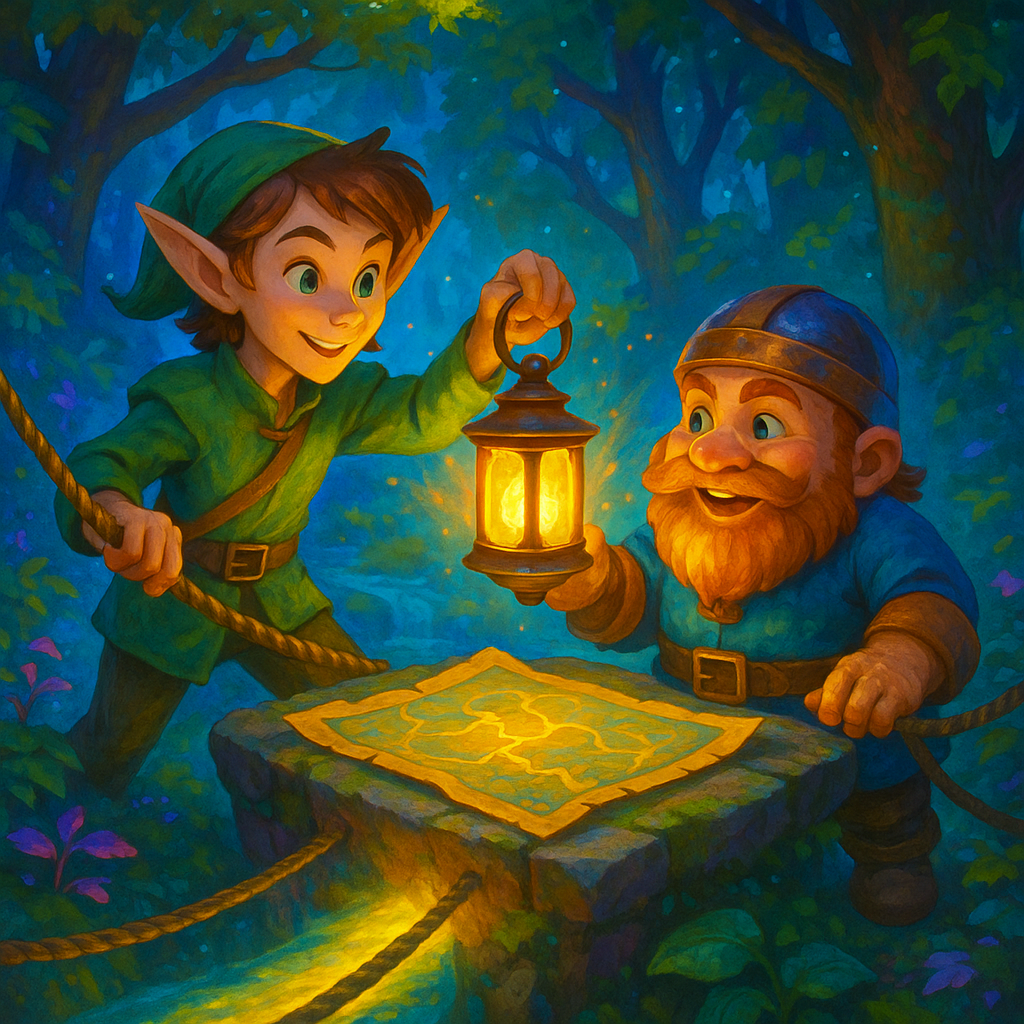
The research on cooperative play we mentioned earlier is no coincidence for Rolin. It’s exactly the mechanism an educational role-playing game is built on. In a story-based adventure, characters don’t have unlimited resources: a single lantern to cross a dark bridge, a single map, a potion that only stretches to one person. Children have to decide together how to divide what little they’ve got so that the mission moves forward for everyone.
Nobody tells them “now it’s time to share”. They discover it because, inside the story, there’s no other way to reach the end. They practise giving way, waiting their turn and trusting that the other person will give way too when it’s their turn, with their hands busy with something they care about, not listening to an explanation of why sharing is good.
That’s what we truly believe at Rolin: children don’t learn to share because we explain it better. They learn by sharing, inside something they care about enough to really try. When they play, they’re working. When they work, they’re playing.
It isn’t a character problem, it’s a skill under construction
The “it’s mine” at the park says nothing about whether you’re bringing your child up well or badly. It says they’re still building a skill, and skills don’t get built with a thirty-second lecture in the middle of the park. They get built with repeated practice, models to watch and real occasions to decide for themselves.
If you’d like to work on this at home in a way that doesn’t rely on speeches or on forcing anything, the free guide at metodorolin.com gives you a first step for practising it with your child this very week.