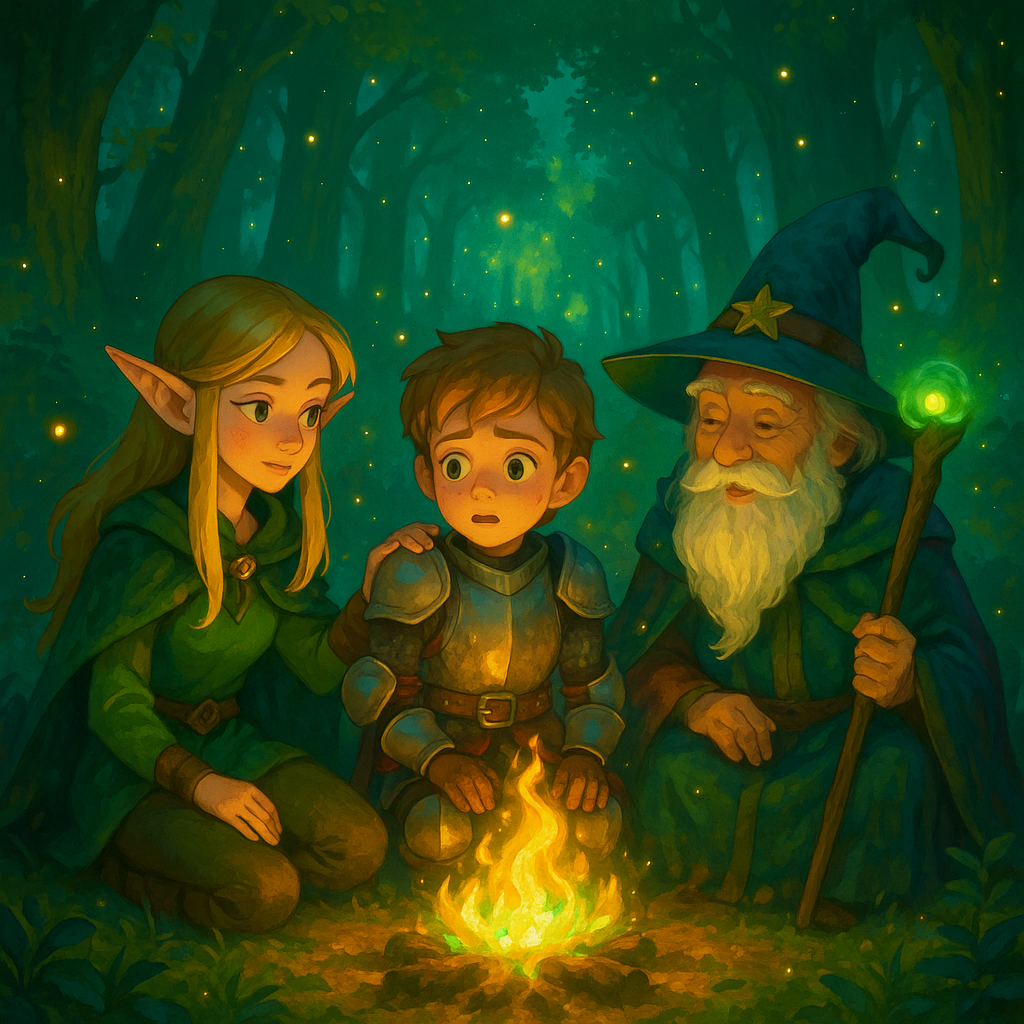
Your child has spent half an hour telling you, without being asked, how they convinced the rest of their group not to attack the wounded dragon and to look for another way out. They’re thrilled. One wanted to charge straight in, they tell you, another was scared, and they suggested waiting. They have no idea they’ve just described a textbook case of emotional regulation. All they know is that they’ve been playing. That’s the thing about educational role-playing games for children.
That’s exactly what a growing body of research is trying to explain: why educational role-playing games for children get them practising emotional skills that three years of talks can’t. For a long time this rested more on intuition than on data. In 2026 that intuition has backing. There are serious studies, in real school settings, that put a name to what parents and educators were already seeing: when a child plays a role, they aren’t wasting time. They’re training the emotional brain in the only conditions where that training works.
That’s what this post is about. What the science says, without the trimmings, and why it fits so well with what you already knew from experience.
The study that changes the frame
In 2025, a journal available on ScienceDirect published a paper by researchers Richard Stubbs and Nikolas Sorensen called Tabletop Role-playing Games and Social and Emotional Learning in School Settings. Its central conclusion is simple and powerful: narrative role-playing games give children structured opportunities to practise social skills, emotional regulation and group problem-solving, in a safe environment.
The key word there is “practise”. Not “learn about”. Not “listen to”. Practise.
The authors base their analysis on Albert Bandura’s social learning theory, one of the most solid frameworks in developmental psychology: we learn by watching, imitating and, above all, rehearsing behaviours in a setting where mistakes carry no real cost. A role-playing game creates exactly that setting. A child can get it wrong, lose, get angry, make up and try again, all inside a story.
And there’s one detail that’s decisive for any family or school: the study describes these games as a low-cost intervention. A character, paper, a pencil and some dice. That’s all it takes to start working on skills that would normally call for expensive, specialised programmes.
What the brain is training when a child plays a role
This is the heart of it. When a child says “now I’m the guardian of the forest and I have to decide whether to let the stranger through”, their brain is doing something it doesn’t do while listening to a lecture on trust.
First, they have to step into someone else’s skin. That switches on perspective-taking, the basis of empathy. You aren’t explaining how the other person feels: they’re feeling it from inside a character.
Second, they have to decide under emotional pressure. Things happen in the game. A teammate rushes in. A plan goes wrong. Fear turns up, or frustration, or the anger of things not going the way they wanted. And they have to keep playing with all that on board. That’s self-regulation in its purest form: noticing the emotion, not letting it sweep you away, and choosing the next step.
Third, they have to negotiate with others. A well-designed role-playing game can’t be won alone. The boy who wants to go straight in runs up against the girl who’d rather wait. And between them, with no adult telling them how, they have to reach a shared decision. That’s where the social skills get trained that no whiteboard exercise can reproduce.
Research on children’s emotional self-regulation has been pointing the same way for years. Dramatic play, according to several recent reviews, lets children express deep wishes and feelings, recognise their emotions and, only afterwards, learn to manage them. You can’t regulate what you haven’t first felt. And play is where feeling comes cheap.
Why it works where talks fail
If you’ve read other Rolin posts, this will sound familiar. The problem with the directive conversation (“you have to be patient”, “you have to wait your turn”, “we don’t shout when we’re angry”) is that it hands a child the conclusion without the journey. And a child’s brain doesn’t file other people’s conclusions. It files its own experiences.
A role-playing game reverses the order. The experience comes first: the child gets angry because the group isn’t listening, reacts badly, things get worse, and they live through it. Then, and only then, comes the reflection. And at that point “maybe shouting wasn’t the best way out” isn’t a telling-off landing on them. It’s their own conclusion, drawn from something they’ve just felt in their own body.
That’s why a study published in Frontiers in Psychology in 2025, focused on educational live-action role-playing games, found measurable improvements in participants’ social-emotional competence after the experience. Not because someone explained emotions better. Because they put them into play.
This is the difference between knowing and doing. A child can know by heart that you have to listen to others and be unable to do it when they’re angry. Play doesn’t work on what they know. It works on what they do when nobody’s correcting them.
The adult’s role: neither teacher nor spectator
There’s a common misunderstanding here. If the game teaches on its own, is the adult surplus to requirements? Quite the opposite. The research is clear that these benefits appear when the game is led or supported by an adult who can read what’s going on. Free play has its value, but the big social and emotional leap comes when someone holds the structure.
That adult doesn’t give lessons. They do three things: set up situations that force a decision, watch how the child gets through them, and at the end open a short conversation about what happened. “What happened when the group didn’t follow you?” “How did you sort it out?” “What would you do differently on the next adventure?” That conversation, based on a real and recent experience, is worth more than ten explanations in advance.
At Rolin we call it being the bridge. The adult, whether a mother, father, teacher, lunchtime supervisor or therapist, isn’t the obstacle between the child and the learning, nor the one who learns on their behalf. They’re the one who designs the terrain and then steps back just enough for the child to cross it.
What this means for your home or your classroom
If you’re a parent, the practical consequence is a relief: you don’t need to be a psychologist to work on your child’s emotions. You need a good game, a story they care about and the discipline to ask questions instead of giving answers. A single well-supported session a week does more for their self-regulation than a month of “behave yourself”.
If you’re a teacher, a lunchtime supervisor or a coordinator, the research gives you a solid argument against anyone who still thinks playing is the opposite of learning. It isn’t. According to the 2025 evidence, role-playing is one of the most efficient and cheapest routes to working on the five social-emotional competencies in a group. And it does so without children feeling they’re in an “emotions class”, which is exactly what stops most programmes from catching on.
And if you work in child development, in psychology, educational psychology or therapy, the framework fits with what you already use: a role-playing game lets children rehearse skills in a safe space and repeat them until they become automatic, individually or in a small group, depending on the goal.
When they play, they’re working
All this research ends up saying, with data, what we sum up at Rolin in one sentence: when they play, they’re working; when they work, they’re playing. The science of 2025 hasn’t invented anything new. It has confirmed something old that traditional schooling had forgotten: play isn’t a break from learning. It’s learning’s most effective form.
When your child excitedly tells you how they talked the group out of attacking the dragon, they aren’t telling you about a game. They’re telling you that today they practised patience, leadership, listening and handling fear. It’s just that in their version, there’s a dragon. And that’s why, this time, it’s going to stick.
Where to go next
At Rolin, we build every adventure on this principle: children learn to regulate themselves, cooperate and decide while they play, not while we lecture them. The adventures belong to the Rolin game, which is coming soon and is set in the World of Leryenne, a story world that is free for any family to explore. If you’d like to see how this translates into specific missions for children aged 8 to 12, take a look at the free guide.